Back after 8 years
Roopkund
The Skeleton Lake
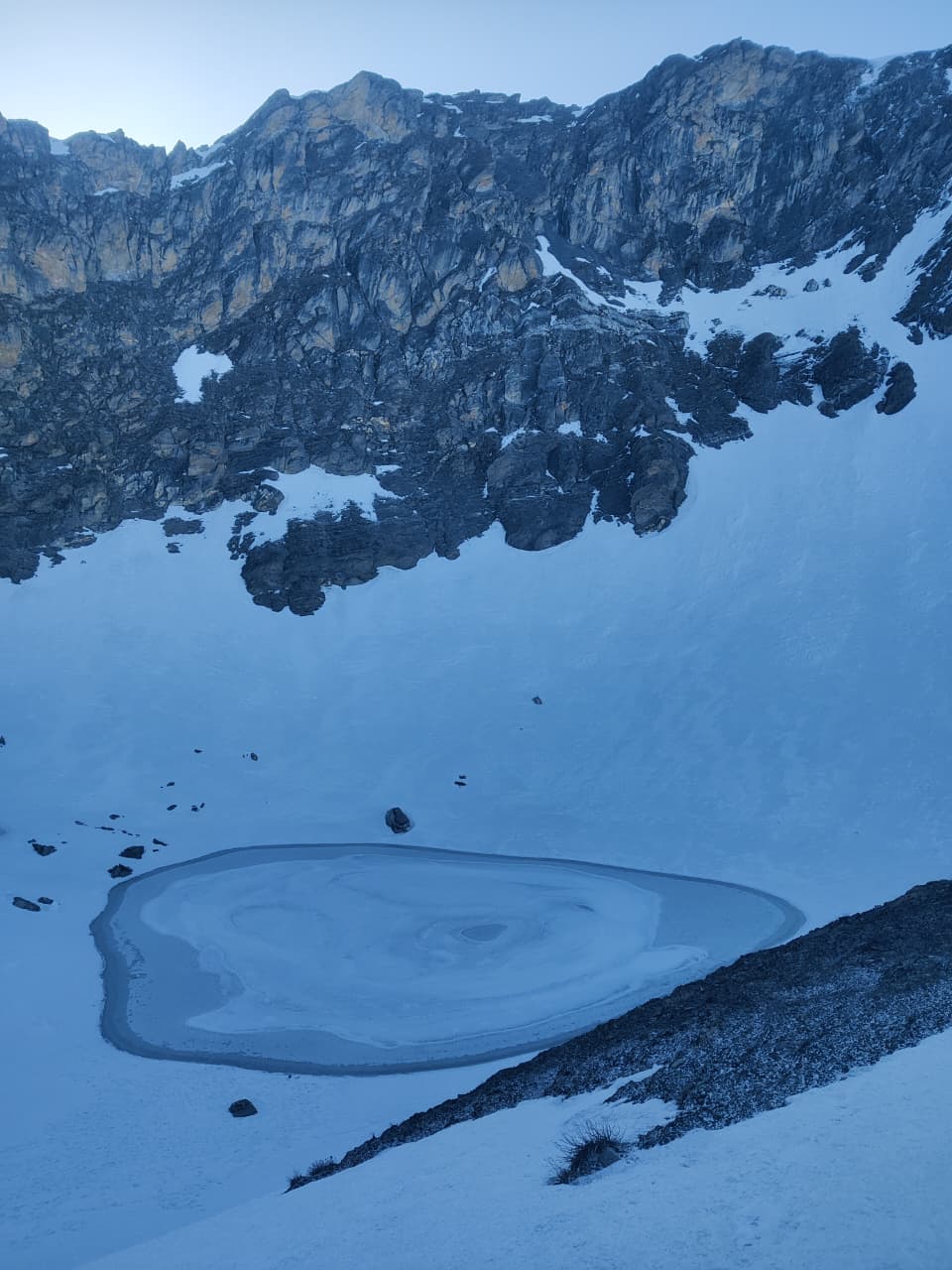
Roopkund at 15,750 ft. Human skeletal remains surface at the lake bed for a few weeks each year as the ice retreats. Our 29 September batch is one of the first since the Supreme Court lifted the camping ban on 20 July 2026.
Per person
₹22,000
High point
15,750 ft
29 Sep – 6 Oct
Only batch this season
8 days
Rishikesh to Rishikesh
15,750 ft
Maximum altitude
15 trekkers
Small group cap
The honest brief
Is Roopkund right for you?
Moderate to difficult, mostly because of altitude and one long summit day, not technical climbing. Comfortable walking 10 to 12 km a day is the real bar.
We build a focused preparation plan around whatever time you have before departure.
Questions before you commit
Is this trek okay for a first-timer?+
Yes. Some of our best experiences on this trail have been with first-time trekkers. They come to the Himalayas wanting to absorb everything, and they leave with learnings that stay with them long after the trek.
The real bar is simple: you should be able to comfortably walk 10–12 km on a hilly trail with a small daypack. Roopkund is graded moderate-to-difficult mainly because of altitude (15,750 ft) and one long summit day, not because of technical climbing or ropes.
Consistency in your prep is the non-negotiable part. Two to four weeks of brisk walking, stairs and a few longer weekend hikes is usually enough. Stick with it, and we will help you do the rest.
How fit do I need to be?+
Think of it like being able to walk uphill for 5–6 hours at a steady pace while carrying a 4–6 kg daypack, and still feel steady the next morning. You do not need a gym or running background. Two to four weeks before the trek, try to walk 8–10 km twice a week, climb stairs with a loaded backpack, and do basic leg and core exercises.
If you are unsure whether this is for you, call or WhatsApp Manoj and talk it through. If you would rather just book, go ahead and describe your routine clearly in the fitness section of the booking form. Manoj will read it, tell you the honest truth, and you can still decide. If you choose not to go ahead after that conversation, we will refund your full amount as long as you let us know within 24 hours.
One thing worth knowing: the mountains have a way of showing you how tough you really are, more mentally than physically. That is the part most people end up being proud of.
What are the trail conditions like?+
The route changes character each day. You start in mixed forest and oak-rhododendron, open into the wide meadows of Ali Bugyal, then move into higher, rockier terrain near Patar Nachauni and Bhagwabasa. Day 6 is the longest: a pre-dawn start to Roopkund and back to Patar Nachauni. Trails are well-defined but can be steep, loose, or snowy depending on the weather. Poles help a lot.
How do we handle altitude and safety?+
Safety is built into the pace, not just the kit. The itinerary has enough acclimatisation built in, and the team checks how everyone is feeling each evening. Your trek is led by certified trek leaders. At least one lead on every DevTrails departure is Wilderness First Responder certified, and several of our leads also hold BMC and AMC mountaineering qualifications from India's recognised institutes. Others are trained directly by leaders who do. The team also carries a full first-aid kit, portable oxygen, a pulse oximeter, and communication devices. Groups are intentionally small so the lead can notice early signs of altitude discomfort and adjust the plan.
If you still have questions after reading this, talk to Manoj. He has done these treks himself and is usually the best person to answer doubts, even the ones that come up after you have googled everything.
Where do we sleep and what do we eat?+
At Lohajung you stay in a simple guesthouse or homestay. On the mountain you sleep in twin-share premium tents with sleeping mats. Meals are hot, vegetarian and built for altitude: rice, lentils, seasonal vegetables, porridge, soup, roti, snacks and plenty of warm drinks. Nothing fancy, but food that keeps your body steady while you climb. Tea and drinking water are provided throughout. Any allergies, dietary restrictions or foods you cannot eat must be shared with us in detail before the trek so we can plan around them.
What gear do I need to bring?+
Layered clothing is the key. Pack quick-dry trek pants, dri-fit t-shirts, thermal inners, a fleece or softshell mid layer, a warm down or synthetic jacket, a rain jacket and rain cover, broken-in high-ankle trekking shoes, woollen socks, gloves, a woolen cap, sun cap, UV sunglasses, SPF 50+, a headlamp, two trekking poles, and two one-litre water bottles.
You will carry two bags: a daypack (20–30 litres, 4–6 kg) with water, rain jacket, snacks, sun protection, camera and small first-aid. This one stays with you every walking day. Your main backpack (50–60 litres) holds extra layers, camp footwear, toiletries and other camp comforts you want at the tents; it does not carry the sleeping bag. If you prefer not to carry your main backpack on trekking days, a porter or mule can offload it for ₹2,400 for the full trek.
You do not need to buy everything. Down jackets, trekking shoes, poles and backpacks are easily available on rent. You can book them online through SharePal, or we can arrange them through our local Dehradun vendor. Reach out to Manoj for details. If this is your first trek, we honestly recommend renting over buying. Good gear is expensive, you will not know your preferences until you have walked a few days in the mountains, and renting lets you try quality equipment for a fraction of the price. Buy only once you know trekking is for you. We send a complete checklist after registration.
What is included in the ₹22,000 fee?+
The fee covers Rishikesh-to-Rishikesh transport, accommodation at Lohajung, twin-share tents on trek, all meals during trekking days, trek permits and forest fees, a certified trek lead and local guide, first-aid support, and trek insurance. It does not include your travel to Rishikesh, personal trekking gear, or personal expenses. Optional porter/mule support is available for ₹2,400 for the full trek.
Where do we start from on Day 1?+
We pick up from Backstays Laxman Jhula, Rishikesh around 5:00 AM. The exact boarding time is shared with your group before departure, once everyone's travel is confirmed.
The real hook
Why it is called Skeleton Lake
Roopkund sits at the bottom of a small cirque at roughly 16,000 ft. For a few weeks most years, as the ice retreats before refreezing, human skeletal remains become visible at the lake bed and shoreline. That is the reason the name Skeleton Lake travels so much further than the map name.
A 2019 DNA study in Nature Communications, led by Harvard and Indian researchers, analysed remains from the site and found three genetically distinct groups separated by roughly 1,000 years. Around 23 individuals carried South Asian ancestry and dated to about 800 CE. Another 14 carried eastern Mediterranean ancestry and dated to about 1800 CE. One carried Southeast Asian ancestry. These were not one event. They were several unrelated groups of people who died there centuries apart.
Local legend, and one theory, attributes at least some of the deaths to a sudden, violent hailstorm. Skull fractures are consistent with blunt, rounded impact from above. We present this as legend and theory, not as a proven explanation.
It is also worth saying honestly: decades of tourists and researchers removing bones mean a visitor today sees far less than the dramatic "hundreds of skeletons scattered everywhere" described in older accounts. The mystery is real, but the scene is quieter now.
The value differentiator
Ali Bedni Bugyal is not a footnote
Most itineraries treat the meadows as the approach. We treat them as part of the main event, because they are a complete, famous trek in their own right.
Ali Bedni Bugyal sits among the largest alpine meadows in Asia. The ridge gives close-up views of Trishul (7,120 m) and Nanda Ghunti (6,310 m). In season the grassland runs for kilometres, and you camp inside it rather than rushing past it.
Ali and Bedni together form one of the largest high-altitude meadow systems in Asia, often ranked alongside the great grasslands of the Himalaya. Most trekkers on this route are headed only for the lake and pass through the meadows as if they were a corridor. We slow down here. You walk the full length of the grassland, camp inside it, and wake up to the Trishul massif filling the horizon.
The lake is the high point, but the meadows are where much of the story lives. Many people who have done both will tell you the bugyal days are the ones they remember longest.
See it before you book
Real photos and videos
The fastest way to know what Roopkund actually looks like right now is to search #roopkund on Instagram Reels. You will find recent videos from trekkers already on the route: current weather, trail conditions, campsite views and what the lake looks like this season. It is more useful than any brochure because it is happening now.
Follow @devtrails.in while you are there. We post our own trail updates, reels from the meadows and honest condition reports as the 29 September batch approaches. Your follow also helps DevTrails reach more trekkers who are looking for real, first-hand information on Roopkund.
Follow @devtrails.inElevation story
The trail, day by day
Six trekking days, roughly 53 km round trip, with one long day at the top. This is an out-and-back trail: up to the lake from Bhagwabasa and back down the same valley.
Day 1
Rishikesh → Lohajung
1,100 → 7,550 ft
Day 2
Lohajung → Didina
8,000 ft
Day 3
Didina → Ali Bugyal
11,700 ft
Day 4
Ali Bugyal → Patar Nachauni
12,750 ft
Day 5
Patar Nachauni → Bhagwabasa
14,100 ft
Day 6
Bhagwabasa → Roopkund → Patar Nachauni
15,750 ft
Day 7
Patar Nachauni → Lohajung
7,550 ft
Day 8
Lohajung → Rishikesh
1,100 ft
Rishikesh → Lohajung
1,100 → 7,550 ft · 260 km drive
Lohajung → Didina
8,000 ft · 9–10 km · forest
Didina → Ali Bugyal
11,700 ft · 8 km · high meadow
Ali Bugyal → Patar Nachauni
12,750 ft · 5–6 km · rolling meadow
Patar Nachauni → Bhagwabasa
14,100 ft · 6 km · steep ascent
Bhagwabasa → Roopkund → Patar Nachauni
15,750 ft · 12 km · summit day
Patar Nachauni → Lohajung
7,550 ft · 13–14 km · descent
Lohajung → Rishikesh
1,100 ft · Return drive
Your ₹22,000 covers
Everything essential on the mountain
Included
- Rishikesh ↔ Lohajung transport, both ways
- Guesthouse or homestay at Lohajung, with meals
- Premium tent stay during the trek, twin sharing
- All meals on trekking days
- Trek permits and forest fees
- Wilderness First Responder certified Trek Lead and local guide
- First-aid support and trek insurance
Not included
- Getting yourself to Rishikesh
- Personal trekking gear
- Personal expenses
Want to travel lighter? Porter or mule support is available at ₹400 a day, or ₹2,400 for the whole trek, for a bag up to 8 kg.
One batch · 29 Sep – 6 Oct
Walk the trail.
Earn the story.
Register online, or speak directly with Manoj if you want to talk through fitness, gear or the trail first.